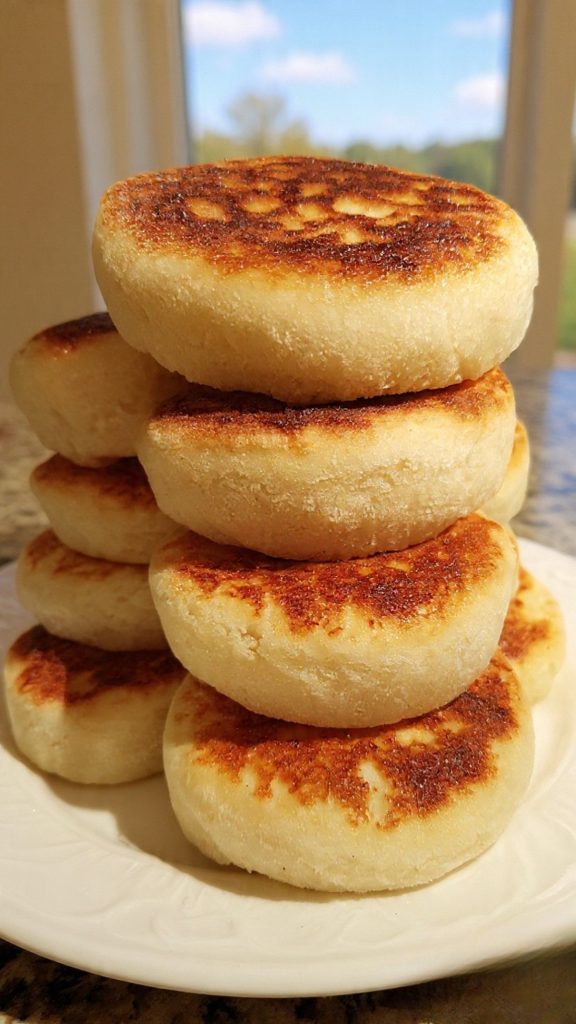
Think others will like this? Share it!
There’s something really satisfying about making English muffins from scratch, especially when the whole thing happens on the stovetop. You start with simple ingredients you probably already have—milk, flour, yeast, butter—and in a couple of hours you’ve got a tray of puffed, golden rounds that smell like a bakery. It’s the kind of project that feels impressive but is actually very doable on a weeknight or a relaxed weekend morning.
The first time I tried homemade English muffins was after a trip to the UK, when I realized how different freshly made ones taste compared to the store-bought packs. At home, the dough is soft and easy to work with, and you can feel it go from sticky to smooth as the gluten develops. While they rise, the kitchen warms up a bit and you get that quiet anticipation knowing breakfast (or brunch sandwiches) are going to be next-level.
What I like most is how flexible they are for entertaining. You can cook the muffins ahead, then set out a topping bar: soft butter, jams, smoked salmon, eggs, or cheese. They toast beautifully, so guests can customize their own. If you enjoy exploring food from different places, homemade English muffins are a fun way to bring a bit of British-style breakfast into your own kitchen, using basic, fresh ingredients and a simple cast iron pan.
English Muffin in Minutes
Click here to get printable version
Tools of the Trade & Core Ingredients
- Stand mixer with dough hook (or a large bowl and strong mixing spoon)
- Large mixing bowl (greased)
- Cast iron skillet or heavy-bottomed skillet
- Baking sheet
- Baking rack for cooling
- Digital thermometer (for checking doneness)
- Measuring cups and spoons
- Fork (for splitting)
- 1 cup milk, warmed to 100–120°F
- 2 ¼ teaspoons active dry yeast (1 standard packet)
- 1 tablespoon sugar
- 2 tablespoons butter, melted
- 1 egg
- 1 teaspoon salt
- 3 to 3 ¼ cups all-purpose flour
- Cornmeal, for dusting the pan and baking sheet
Prep & Assemble
- In a small bowl or measuring jug, combine the warm milk, yeast, and sugar. Stir briefly, then let it sit for about 5 minutes until the surface is foamy and bubbly. If it doesn’t foam, your yeast may be inactive—start over with fresh yeast.
- Pour the yeast mixture into the bowl of a stand mixer. Add 1 cup of flour and mix until smooth. Then add the melted butter, egg, and salt, mixing until everything is evenly combined.
- Begin adding the remaining flour about ½ cup at a time, mixing on low speed. Stop adding flour once the dough comes together in a soft ball and pulls away from the sides of the bowl. The dough should feel soft and slightly tacky, not dry, so you may not need all the flour.
- Knead the dough with the dough hook on medium-low speed for about 5 minutes, until it’s smooth and elastic. If kneading by hand, turn the dough out onto a lightly floured surface and knead for 7–8 minutes.
- Place the dough into a large, greased bowl, turning it once to coat the surface. Cover with a clean towel or plastic wrap and let it rise in a warm, draft-free spot until doubled in size, about 60–90 minutes depending on your kitchen temperature.
- Lightly sprinkle a baking sheet with cornmeal. Punch down the dough to release the air, then divide it into 12 equal pieces. Shape each piece into a smooth ball, then gently flatten into a disk about 3–3½ inches wide. Set the disks on the prepared baking sheet, turning them once to lightly coat both sides with cornmeal.
- Cover the muffins loosely and let them rise again for 30–45 minutes, until slightly puffy. This second rise is important for getting a light texture, so don’t rush this step.
- Preheat a cast iron skillet over low heat for several minutes so it warms evenly. Place a few muffins in the dry skillet, leaving space between them. Cook for 3–4 minutes per side, flipping every minute or so to prevent burning. Adjust the heat as needed to keep the surface golden, not dark brown.
- Continue cooking and flipping the muffins until they’re firm and cooked through. Use a digital thermometer to check the center; it should read between 190–200°F. Transfer cooked muffins to a baking rack to cool completely.
- Once cool, use a fork to split each English muffin around the middle, gently prying it apart to reveal the interior. Toast before serving for the best texture and flavor.
Getting the Nooks and Crannies
The signature texture of a good English muffin is all about those little air pockets inside. To encourage them, keep the dough on the softer side—if you add too much flour, the crumb will be tight. Stop adding flour as soon as the dough forms a soft ball and clears the bowl. The second rise on the shaped muffins is just as important; letting them puff up gently gives the yeast time to create bubbles. When it’s time to split them, always use a fork instead of a knife. Working the fork around the edge tears the interior slightly instead of slicing it cleanly, which preserves and exposes the nooks and crannies so they toast up crisp and hold onto butter, jam, or eggs beautifully.
Stovetop Cooking Tips
Because these English muffins cook on the stovetop, controlling your heat matters more than usual. Preheat your cast iron over low heat for several minutes so the surface is evenly hot before you start. If the muffins are browning too quickly but still feel squishy in the middle, your heat is too high—turn it down and flip more often. Frequent flipping, every 45–60 seconds, helps prevent scorching and promotes even cooking. You can also cover the pan loosely with a lid for a couple of minutes to trap a bit of heat and help cook the centers, especially if your muffins are on the thicker side. If you’re cooking for guests, make a test muffin first to dial in the timing and temperature before filling the whole pan.
Common Questions Answered
Can I make the dough ahead for a brunch party?
Yes, this dough works well for overnight prep, which is great when you’re hosting brunch. Mix and knead the dough as directed, then let it rise just until it’s slightly puffed, not fully doubled. Gently deflate it, cover the bowl tightly, and refrigerate for up to 12–14 hours. The cold slows the yeast, adding flavor while keeping the dough manageable. The next day, let the dough warm at room temperature for 30–45 minutes, shape the muffins, and continue from the second rise. Don’t skip that warm-up time or the dough will be stiff and slow to rise.
Why do my English muffins look done outside but feel doughy inside?
This usually means your pan heat is too high or the muffins are too thick. The outside browns before the center has time to cook through. Keep the heat on low and give the skillet a long preheat, so it cooks more gently and evenly. You can also press the muffins very slightly with a spatula during cooking to keep them at an even thickness without flattening them too much. Always rely on a thermometer—if they’re not at least 190°F in the center, leave them on the pan a bit longer, flipping often to avoid burning.
Can I use whole wheat flour or alternative flours in this recipe?
You can swap part of the all-purpose flour for whole wheat, but it’s best to start with no more than 25–30% whole wheat so the muffins stay light. Whole wheat absorbs more liquid, so you may need an extra splash of warm milk if the dough feels stiff. Alternative flours like oat or almond don’t provide the same gluten structure, so using them in large amounts will give you dense, crumbly muffins. For gluten-free baking, look for a recipe developed specifically for that. In this version, aim for a soft, slightly tacky dough to keep the texture open and tender.
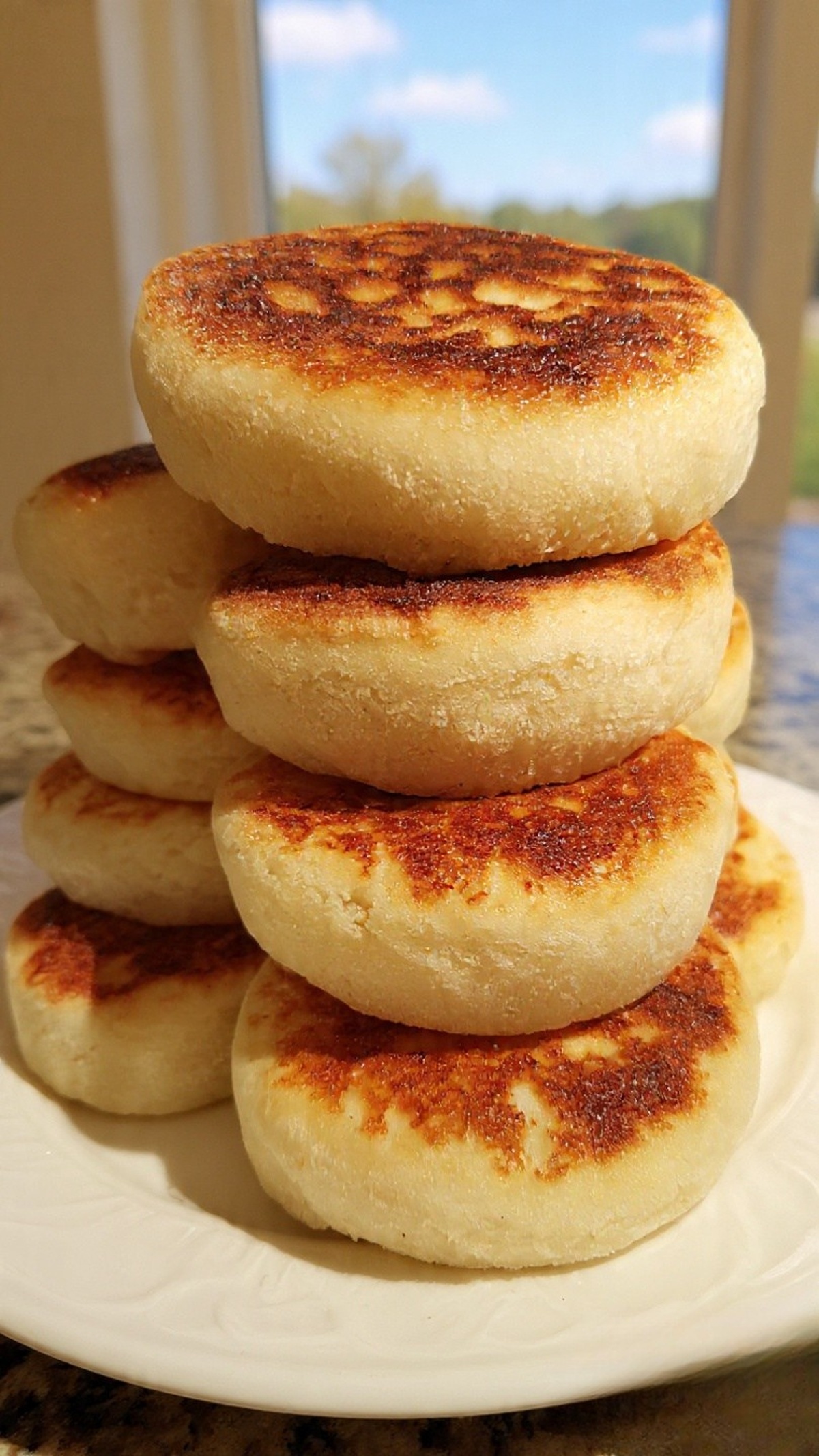
English Muffin
Equipment
- Stand mixer with dough hook (or mixing bowl)
- Cast iron skillet or heavy-bottomed skillet
- Baking sheet
- Wire cooling rack
Ingredients
- 1 cup milk warmed to 100–120°F
- 2 1/4 teaspoons active dry yeast or 1 package
- 1 tablespoon sugar
- 2 tablespoons butter melted
- 1 large egg
- 1 teaspoon salt
- 3 - 3¼ cups all-purpose flour start with 3 cups, add up to 3¼ cups as needed
- cornmeal for dusting
Instructions
- Warm the milk to about 100–120°F. Sprinkle in the yeast and sugar, stir briefly, then let the mixture sit for approximately 5 minutes until it becomes foamy.
- Pour the foamy milk into the bowl of a stand mixer. Add one cup of the flour, then add the melted butter, the egg, and the salt. Mix briefly to combine.
- With the mixer running, add the remaining flour in ½-cup increments, stopping when the dough comes together into a soft ball; you may not need all the flour.
- Knead the dough on low speed with the dough hook for about 5 minutes, until it’s smooth and slightly elastic.
- Lightly grease a large bowl, place the dough inside, cover with a towel or plastic wrap, and let it rise until roughly doubled in size.
- Punch the risen dough down and divide it into 12 equal portions. Shape each portion into a ball, then gently flatten to muffin thickness.
- Dust a baking sheet with cornmeal and place the formed muffins on it. Cover and allow them to rise again for 30–45 minutes until puffy.
- Heat a cast-iron or heavy skillet over low heat until hot but not smoking. Cook the muffins 3–4 minutes per side, flipping as needed to prevent charring; continue until fully cooked.
- Check doneness by inserting a digital thermometer into the center of a muffin; the internal temperature should read between 190–200°F.
- Transfer cooked muffins to a wire rack to cool. Once cooled, split them open using a fork to preserve the nooks and crannies.